Executive Overview
FYNIYA (Natural Language Marketplace) began with a simple idea: finding the right service provider should feel like having a conversation, not filling out forms or navigating complicated filters.
Positioned as my first hands-on AI product exploration, I explored how AI could make marketplace discovery more intuitive by allowing buyers to describe what they need in everyday language and enabling service providers to describe their businesses naturally.
Project Maturity: Functional MVP — local development and testing. FYNIYA was not publicly launched. The prototype was evaluated against a synthetic provider dataset to explore and validate the core conversational discovery experience, without booking, payments, or user management.
The Problem
Traditional marketplaces often depend on predefined categories, rigid filters, and structured search fields. These constraints can make discovery difficult when buyers have requirements that do not fit neatly into predefined taxonomy options.
Example scenario:
“I need an event decorator in Bangalore for a small wedding.”
The challenge was to understand the genuine intent behind the request, extract relevant operational constraints (service type, location, event context), and retrieve suitable providers rather than relying solely on surface-level keyword matching.
What I Built
FYNIYA is a functional, locally tested AI-powered marketplace discovery MVP built around two primary natural-language workflows:
- Provider onboarding through natural language: Providers describe their business, services, experience, location, and pricing in their own words. AI interprets the description and extracts structured business information to support downstream indexing and discovery.
- Buyer discovery through natural language: Buyers describe their requirements conversationally. The system interprets their intent, queries the provider directory, and presents ranked results with explicit explanations of why each provider matches.
Product Walkthrough & Genuine Implementation Evidence
The following walkthrough illustrates the verified end-to-end user experience captured from the functional prototype running in a local testing environment.
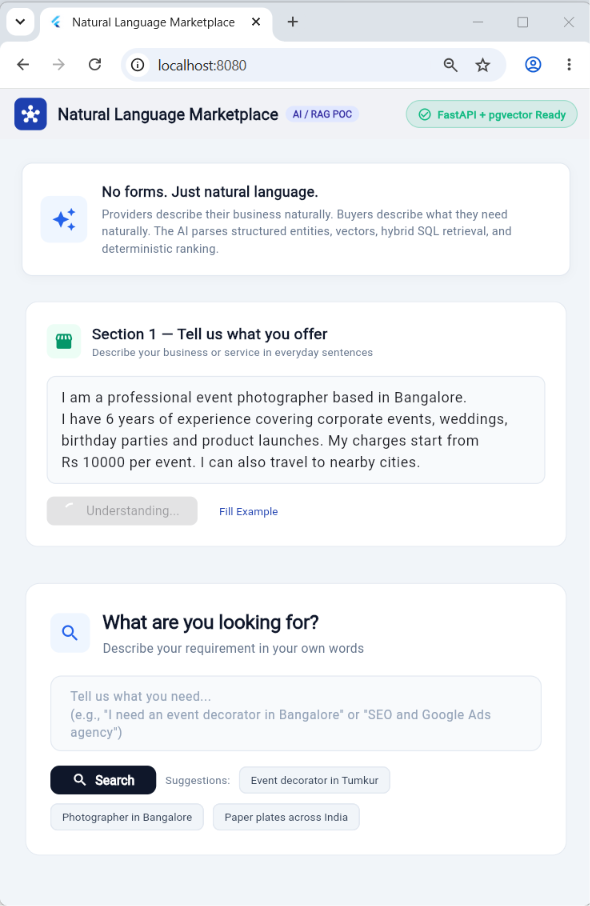
1. Provider Onboarding Through Natural Language
Providers describe their business, services, experience, location and pricing in their own words. The screenshot depicts a provider submitting a natural-language business description while AI understanding is actively in progress.
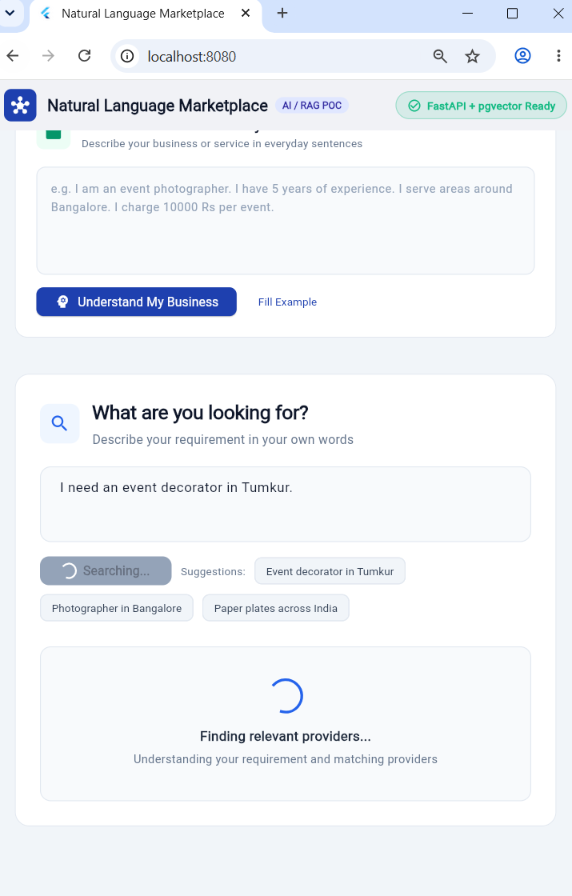
2. Conversational Buyer Search
Buyers initiate discovery by describing their requirement in everyday language without needing to select categories or toggle complex filters.
3. Intent Understanding & Entity Extraction
Before executing retrieval, the system transparently identifies the core requirement, displaying extracted service categories and geographical constraints back to the buyer.
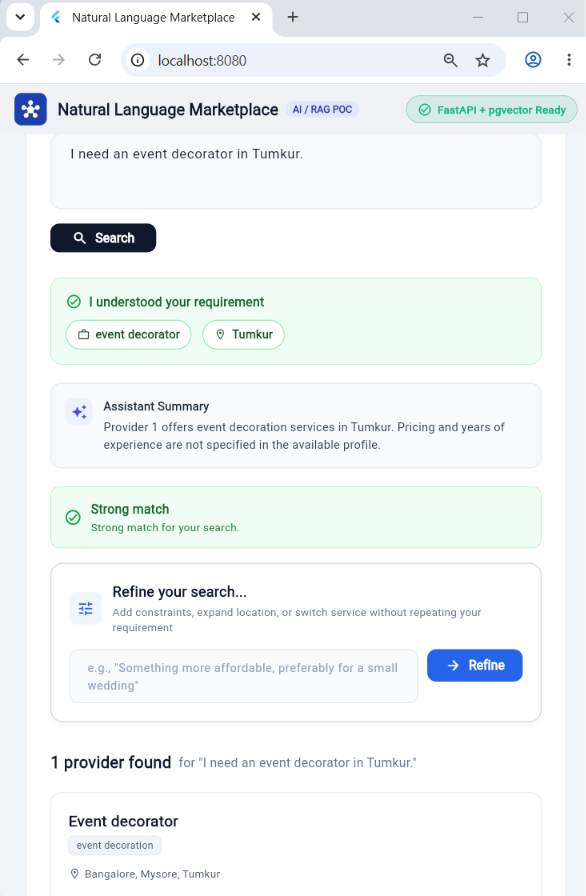
event decorator, location: Tumkur) alongside an AI-generated assistant summary and match signal.
4. Ranked Provider Results & Match Explanation
Matching providers are retrieved and scored deterministically, presenting explicit match criteria so buyers understand exactly why a provider is recommended.
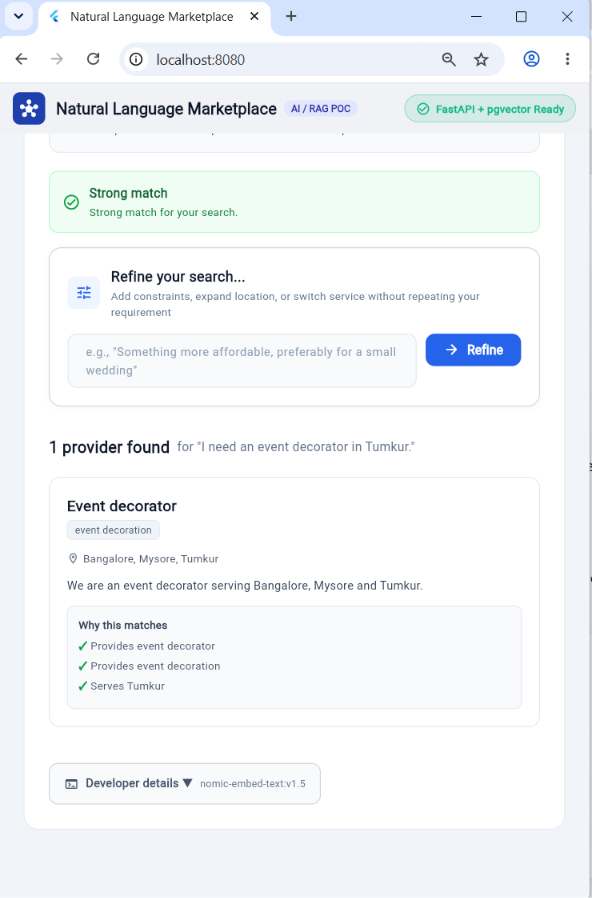
nomic-embed-text:v1.5).
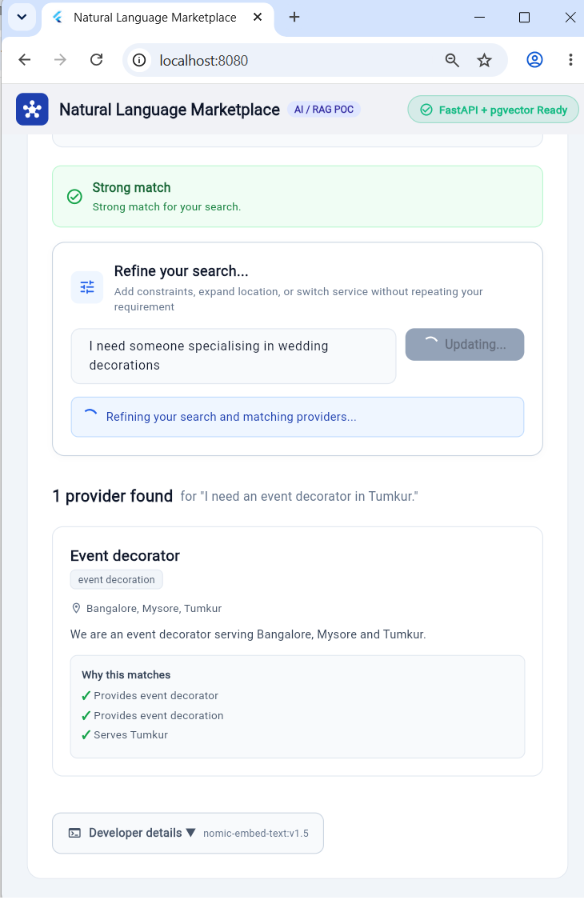
5. Multi-Turn Conversational Refinement
Buyers can refine their initial request by adding constraints or specific nuances without re-entering prior location or service context.
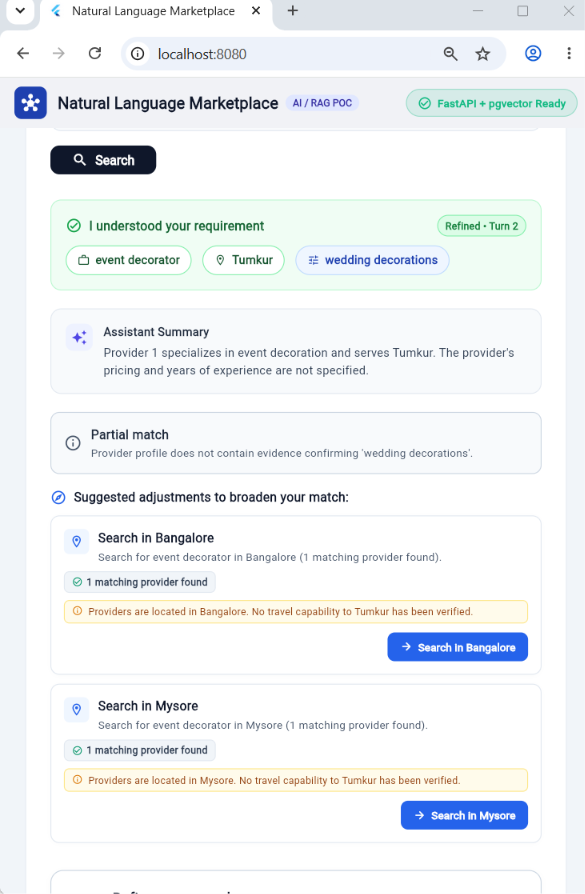
6. Partial-Match Detection & Transparency
When a buyer introduces a constraint that cannot be fully verified from the provider’s structured profile, the system highlights the partial match rather than generating unsupported claims.
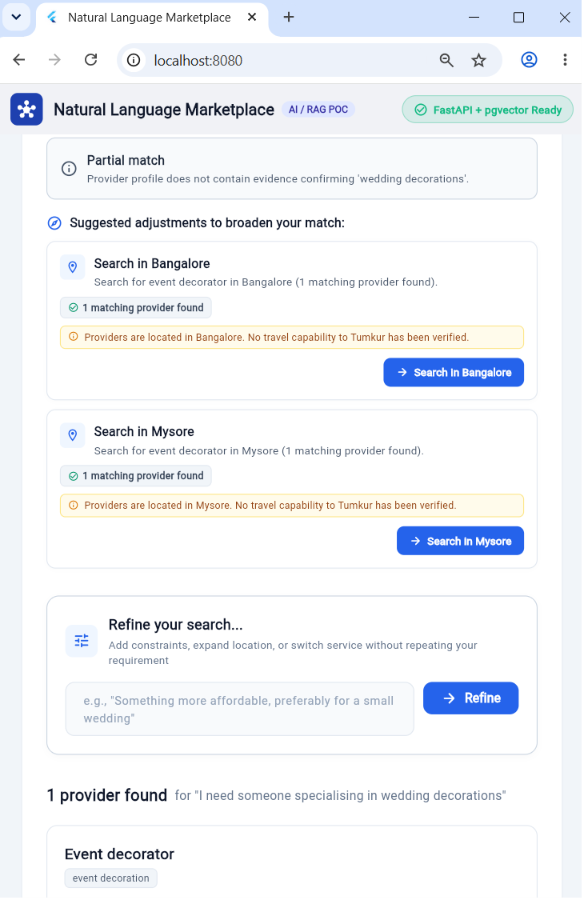
7. Search Recovery & Suggested Adjustments
When constraints restrict suitable matches, the system dynamically suggests actionable alternative options to assist buyer discovery.
AI and Technical Approach
The core technical architecture deliberately separates language understanding from business eligibility and ranking decisions:
- LLM-Based Intent Understanding: Extracts service categories, locations, budgets, and constraints from natural-language descriptions.
- Semantic Embeddings: Represents provider descriptions and buyer queries as dense vector representations using Nomic Embeddings.
- Hybrid Retrieval: Combines structured SQL relational filtering with vector similarity search via PostgreSQL and
pgvector. - Explainable Ranking: Applies deterministic scoring algorithms across semantic relevance, category alignment, location proximity, and budget.
- Grounded RAG Responses: Synthesizes assistant explanations strictly from retrieved provider database fields, preventing ungrounded model output.
- Conversational Refinement: Retains search parameters across dialogue turns, enabling progressive query refinement.
- Search Recovery: Proposes relaxed constraints, alternative locations, or related services when exact match volume is low.
[Natural Language Input]
         │
         ▼
[LLM Intent Parser] ──────────► [Structured Extraction: Category, Location, Budget]
         │                                       │
         ▼                                       ▼
[Nomic Embeddings] ──► [Hybrid Retrieval: SQL Filter + pgvector Cosine Search]
                                                 │
                                                 ▼
                                   [Deterministic Ranking]
                                                 │
                                                 ▼
                                [Grounded Match Explanation]
What the Prototype Demonstrated
Evaluation of the prototype confirmed the feasibility of natural-language discovery for two-sided marketplaces:
- Verified natural-language provider profile understanding and entity extraction.
- Intuitive natural-language buyer search without manual filter configuration.
- Robust hybrid SQL and vector-based retrieval performance.
- Transparent ranked provider results with factual match explanations.
- Seamless conversational search refinement across multiple dialogue turns.
- Reliable partial-match handling and alternative search suggestions.
- Grounded responses preventing hallucinated provider qualifications.
The initial benchmark recorded Rank-1 retrieval for four targeted in-domain queries against the canonical test dataset. Negative and constraint-violating queries were also validated during local testing.
Technology Stack
The prototype was constructed with lightweight, robust technologies optimized for local execution:
- Frontend Application: Flutter Web (responsive conversational interface)
- Backend API Layer: Python, FastAPI
- Database & Vector Store: PostgreSQL with the
pgvectorextension, managed via SQLAlchemy ORM - AI & Embedding Inference: Ollama running locally, Qwen3 language model, and Nomic Embeddings
Project Maturity & Scope Boundaries
FYNIYA was implemented as a functional MVP for local development and testing.
Key boundaries of the prototype:
- Evaluated against a synthetic provider dataset to validate conversational discovery.
- Not launched commercially or deployed into public production.
- Excluded transactional marketplace features such as payment processing, booking agreements, and user authentication.
Key Learnings & Architectural Takeaways
FYNIYA served as an essential practical foundation in my AI leadership journey:
- Beyond Standalone Language Models: It moved my practice from evaluating standalone LLMs to architecting end-to-end AI applications—integrating natural-language inputs, dense embeddings, vector retrieval, deterministic ranking, grounded synthesis, and interactive UI.
- Separation of LLMs and Business Logic: A reliable AI product must not delegate every decision to a generative model. Delegating language interpretation to AI while retaining deterministic application logic for retrieval constraints and ranking creates a more explainable, controlled, and trustworthy system.