Executive Overview & Product Vision
TradePilot is evolving into a quantitative market intelligence platform focused on recognising recurring price-action patterns across historical market data and evaluating their behaviour to identify potential opportunities in live markets.
In volatile financial markets, conventional technical analysis often reduces price action to static visual chart formations evaluated in isolation. TradePilot is designed around a deeper quantitative objective: it is not merely to identify chart formations, but to understand their historical behaviour and assess their potential relevance in current market conditions.
By systematically indexing multi-year historical datasets, TradePilot evaluates how identified patterns have behaved across varying market regimes, examines the structural characteristics and outcomes of similar historical setups, and builds the analytical foundation to inform live-market observation.
The platform combines deterministic pattern analysis today with an ongoing research direction involving machine learning and artificial intelligence to improve pattern recognition, classification, and probabilistic outcome assessment over time.
Project Maturity: Active Research Prototype — local development and testing environment. Broker integration has been tested through OpenAlgo Analyzer Mode. The platform currently validates deterministic pattern recognition algorithms, historical market data persistence, and continuous intraday context reconstruction.
Pattern Families & Implementation Maturity
A core architectural principle of TradePilot is maintaining total transparency regarding what is currently implemented versus what remains in active research.
The platform targets several core classical price-action pattern families, maintaining an explicit distinction between currently implemented capabilities and planned future research:
| Pattern family | Public status |
|---|---|
| Volatility Contraction Pattern (VCP) | Deterministic pattern recognition implemented |
| Bull Flag | Deterministic pattern recognition implemented |
| Triangles | Planned future pattern family — not implemented |
| Sideways Consolidation | Planned future pattern family — not implemented |
| Range-Bound Structures | Planned future pattern family — not implemented |
Implementation Note: Only the Volatility Contraction Pattern (VCP) and Bull Flag pattern families have deterministic pattern recognition routines currently implemented. Triangles, sideways consolidations, and range-bound structures represent planned future pattern families and are not yet implemented in the prototype.
Deterministic Implementation vs. Machine Learning & AI Research
TradePilot maintains an explicit separation between its existing deterministic functionality and its future research roadmap:
┌─────────────────────────────────────────────────────────────────────────────┐
│                      CURRENTLY IMPLEMENTED SYSTEM                           │
│                      (Deterministic & Empirical)                            │
├─────────────────────────────────────────────────────────────────────────────┤
│  • Deterministic Price-Action Analysis                                      │
│  • Implemented VCP and Bull Flag Pattern Recognition                        │
│  • Historical Market Data Research Across Persisted Daily OHLCV Bars        │
│  • Quantitative Historical Event Identification and Evaluation              │
│  • Continuous Multi-Session 1-Minute Intraday Context Reconstruction        │
└──────────────────────────────────────┬──────────────────────────────────────┘
                                       │
                                       ▼  (Future Research Direction)
┌─────────────────────────────────────────────────────────────────────────────┐
│                    RESEARCH & FUTURE DEVELOPMENT ROADMAP                    │
│                    (Probabilistic Modeling, ML & AI)                        │
├─────────────────────────────────────────────────────────────────────────────┤
│  • Expanding Pattern Recognition to Additional Price-Action Structures       │
│  • Machine Learning & AI for Pattern Recognition & Classification           │
│  • AI-Assisted Pattern Intelligence                                         │
│  • Historical Pattern Behaviour Analysis & Probabilistic Assessment         │
│  • Live-Market Opportunity Identification Using Historical Pattern Memory   │
└─────────────────────────────────────────────────────────────────────────────┘
1. Currently Implemented: Deterministic Capabilities
All currently operational capabilities within TradePilot operate through deterministic mathematical and rule-based analysis:
- Deterministic price-action analysis.
- Existing VCP and Bull Flag pattern detection.
- Historical market data persistence and research across daily OHLCV bars.
- Quantitative historical event identification and evaluation.
- Continuous multi-session 1-minute intraday data reconstruction.
2. Research & Future Development: Machine Learning & AI
Important Distinction: Machine learning and artificial intelligence capabilities represent a future research direction to improve pattern recognition, classification, historical behaviour analysis, and probabilistic opportunity assessment. No machine learning or AI models are currently deployed or functional in TradePilot.
Planned research exploration includes:
- Expanding pattern recognition to additional price-action structures.
- Machine-learning-based pattern recognition and classification.
- AI-assisted pattern intelligence.
- Historical pattern behaviour analysis and probabilistic assessment.
- Live-market opportunity identification using historical pattern intelligence.
Architecture & Broker-Agnostic Integration Pipeline
TradePilot employs a decoupled, modular architecture designed for high-responsiveness analysis and safe simulation. The core pipeline isolates analytical research from execution gateways:
[Flutter Client: Web & Desktop]
               │
               ▼  (REST API)
[TradePilot Backend: Python / FastAPI]
      ├── Historical Market Data Persistence & Querying
      ├── Deterministic VCP & Bull Flag Detection
      ├── Quantitative Event Identification & Evaluation
      └── Multi-Session Intraday Context Reconstruction
               │
               ▼  (Agnostic Broker Protocol)
[OpenAlgo Broker Abstraction Layer]
               │  (Analyzer Mode: Simulation Environment)
               ▼
[Zerodha API Gateway Integration]- Frontend Client: Built with Flutter (supporting Web and Desktop) to deliver high-performance candlestick rendering, smooth historical panning, and multi-resolution zoom capabilities.
- Backend Research Engine: Engineered with Python and FastAPI, managing historical market data ingestion, candle parsing, and deterministic pattern recognition algorithms.
- Data Persistence: Historical market data persistence and structured querying, housing persisted multi-year daily OHLCV candles and high-resolution 1-minute intraday session bars.
- Broker Abstraction Layer: Integrated through OpenAlgo, creating an agnostic execution abstraction that currently interfaces with Zerodha. Broker connectivity has been tested through OpenAlgo’s Analyzer Mode, providing a simulation environment for research and validation.
Supporting Research Foundation: Historical Data & Event Analysis
Historical market data research and quantitative event analysis serve as the supporting research foundation for TradePilot’s pattern intelligence engine.
The following evidence illustrates the underlying historical market data persistence, quantitative event evaluation, and multi-session intraday reconstruction capabilities operating in TradePilot’s local testing environment.
Visual Alignment Notice: The screenshots below illustrate the functional data persistence and event evaluation infrastructure that supports pattern intelligence. They demonstrate deterministic research capabilities; they do not represent machine learning or AI models.
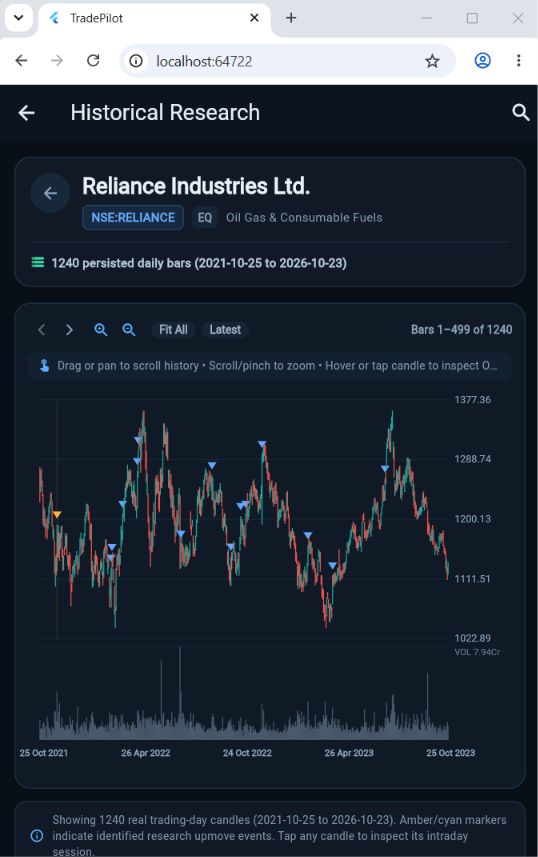
1. Historical Market Research Across Persisted Daily OHLCV Data
TradePilot persists comprehensive multi-year daily OHLCV data across equity instruments (e.g., Reliance Industries Ltd. across 1,240 real trading sessions from 2021 to 2026). The interactive research interface plots historical price trajectories with identifiable anomaly markers, enabling researchers to inspect multi-year macro structure and historical price-action behavior.
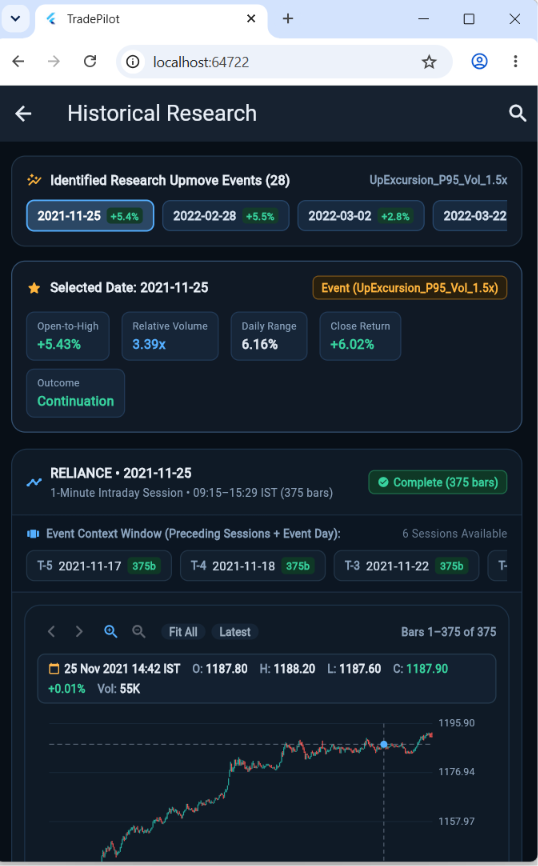
2. Historical Market Event Identification and Quantitative Evaluation
To analyze how price-action patterns behave around significant market moves, TradePilot programmatically identifies historical event days (such as sharp momentum excursions). The system performs quantitative historical event evaluation—analyzing historical price-action behavior and subsequent multi-day outcomes without relying on subjective chart interpretation.
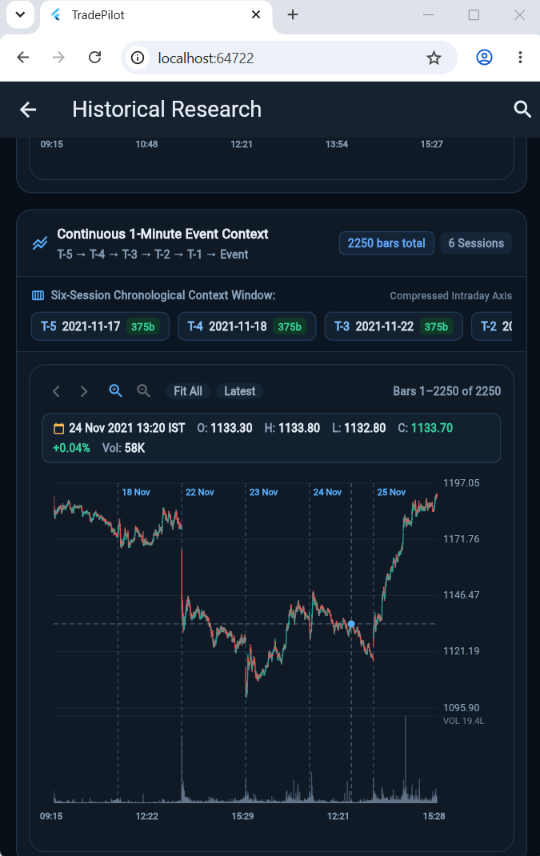
3. Continuous One-Minute Market Context Across Six Trading Sessions
A key research capability in TradePilot is continuous multi-session intraday context reconstruction. Instead of evaluating an isolated trading session, TradePilot stitches together high-resolution 1-minute market data across six chronological sessions (preceding sessions alongside the event day, totaling 2,250 continuous 1-minute bars). This enables researchers to evaluate the structural price evolution leading into historical market events.
Supporting System Interfaces & Operational Architecture
TradePilot’s research capabilities are supported by a unified operating workspace, searchable instrument index, and transparent system health controls.
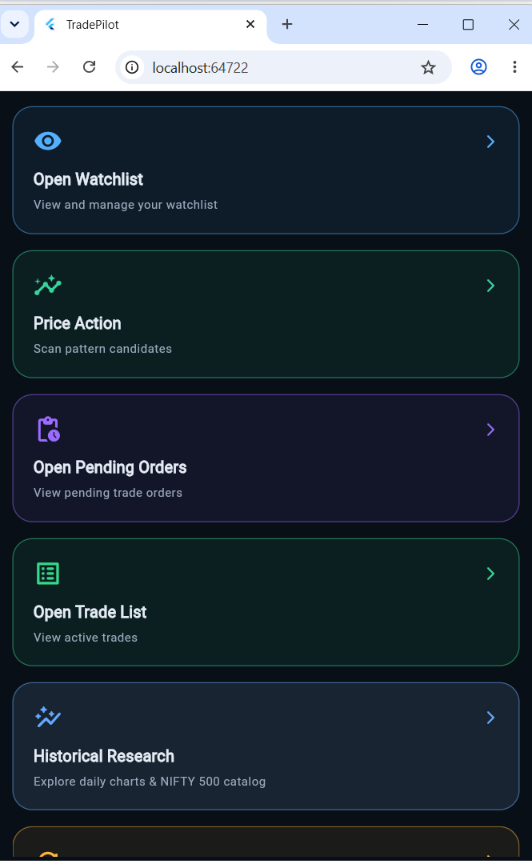
1. Integrated Trading and Research Workspace
The platform provides a consolidated desktop workspace organizing critical operational modules: Watchlist management, Price Action scanning, Pending Order oversight, Active Trade monitoring, and Historical Research exploration.
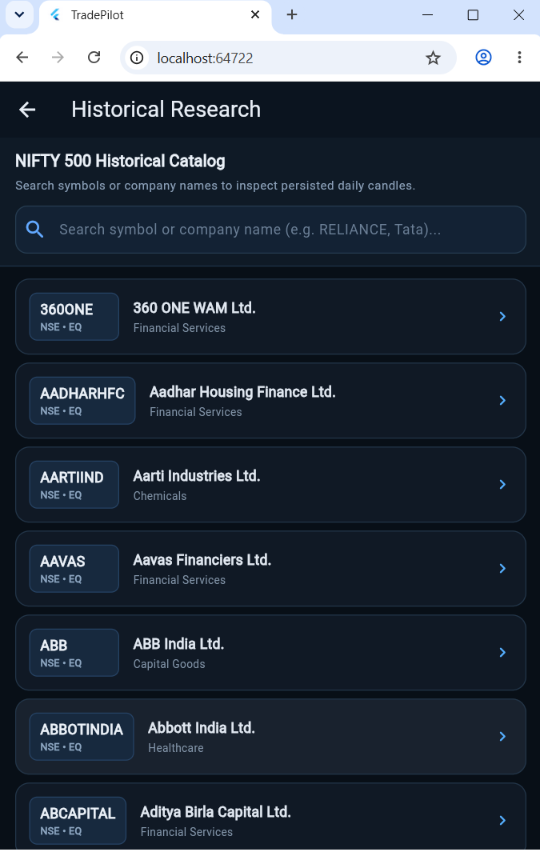
2. Searchable NIFTY 500 Historical Instrument Catalogue
To support scalable quantitative screening across diverse market sectors, TradePilot includes a high-performance instrument catalogue indexing NIFTY 500 constituents. Researchers can query constituent equities by ticker symbol or company name to instantly load persisted daily historical bars.
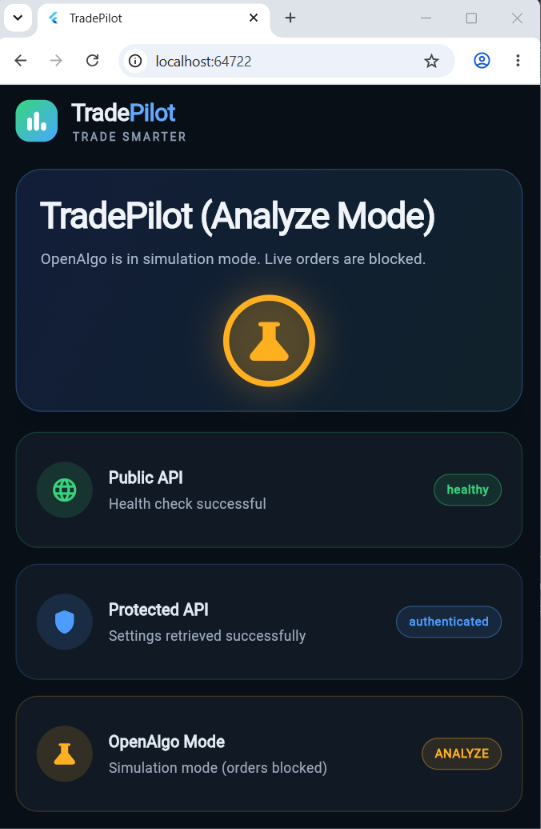
3. Application Health and Simulation Operating Status
System transparency and operational status are monitored through application health checks. The system verifies public endpoint responsiveness, validates authenticated protected configurations, and monitors broker abstraction connectivity. Broker connectivity has been tested through OpenAlgo’s Analyzer Mode, providing a simulation environment for research and validation.
Future Architecture Direction — Hybrid Local/Cloud
TradePilot is designed with a long-term architectural vision targeting a hybrid local/cloud model:
- Local Edge Client (Flutter Desktop): Planned to maintain high-responsiveness interactive charting, fast local panning, and researcher parameter exploration without network latency.
- Future Cloud Scalability Exploration: A future architectural direction to evaluate cloud-based infrastructure for scalable historical market data persistence and compute-intensive analytical workloads.
- Future State Synchronization: A planned design direction to connect local research sessions with centralized historical storage via secure APIs.
Architecture Clarification: This section outlines a future architectural direction, not a currently deployed cloud architecture. Cloud infrastructure, distributed scanning, data lakes, and cloud-based machine learning training are part of future architectural exploration and are not currently implemented or deployed.
Technology Stack
The TradePilot prototype is built with a focused, modular technology stack:
- Frontend User Interface: Flutter Web & Desktop (reactive UI, custom chart canvas rendering, cross-platform compilation)
- Backend API & Analytics: Python, FastAPI (asynchronous endpoints, numerical processing, historical replay pipelines)
- Data Persistence: Historical market data persistence and structured querying (persisted daily OHLCV bars, 1-minute intraday sessions)
- Execution & Abstraction: OpenAlgo Broker Abstraction (standardized order and market data interface)
- Broker Connectivity: Zerodha API Integration (tested in simulation and Analyzer mode)
Scope Boundaries & Confidentiality Safeguards
To maintain strict compliance with organizational confidentiality and regulatory standards:
- Research Prototype Only: TradePilot is not a commercial product, public advisory service, or live automated trading system.
- Simulation Environment: Broker connectivity has been tested through OpenAlgo’s Analyzer Mode, providing a simulation environment for research and validation.
- Confidentiality Safeguards: All proprietary trading rules, scanner parameters, scoring weights, and strategy logic remain strictly confidential and are omitted from this case study.
Key Learnings & Engineering Takeaways
- Patterns Require Behavioural Context: Identifying geometric shapes is insufficient. A pattern’s value lies in understanding its historical behavior, prior consolidation structure, and conditional outcome characteristics across varying market environments.
- Grounding in Deterministic Data First: Complex analytical models cannot compensate for poor underlying data. Establishing robust, continuous time-series persistence (stitching multi-session 1-minute bars without gaps) proved far more foundational than premature machine learning experimentation.
- Decoupling Research from Broker Execution: Isolating the analytics engine from broker APIs via OpenAlgo prevented platform lock-in and guaranteed that research can continue independently of external broker changes.